Back to Resources
Cast Iron Waterbox Repair: Galvanic Corrosion Elimination
Main Condenser — Salt Water Service
Main Condenser · Salt Water Service
The Problem
Galvanic Corrosion at the Cast Iron — Muntz Metal Interface
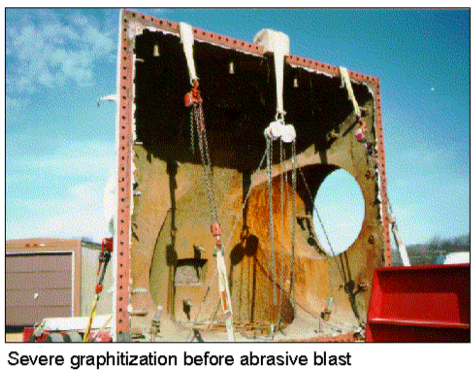
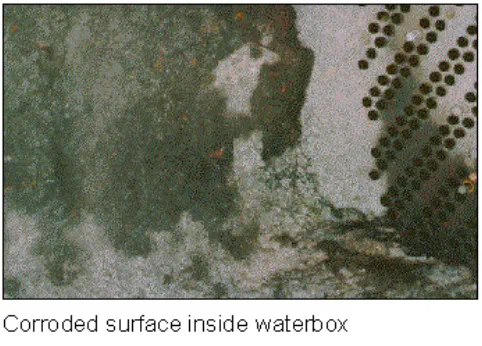
Cast iron main condenser waterboxes in salt water service were experiencing corrosion and metal loss. The most severe damage was concentrated adjacent to the Muntz Metal tubesheet.
Root Cause
Cast iron and Muntz Metal — an alloy of approximately 60% copper and 40% zinc — are widely separated on the galvanic series. In salt water, which acts as an effective electrolyte, the cast iron becomes the anode and corrodes preferentially and aggressively at the interface.
Corrosion Barrier
The coating system was required to protect the cast iron substrate from direct salt water attack.
Electrical Insulation
The system also had to break electrical continuity between the cast iron waterbox and the Muntz Metal tubesheet — eliminating the galvanic cell entirely rather than just slowing it.
Specification
Three-Step Epoxy Coating System
Application
Waterbox Interior
Substrate
Cast Iron
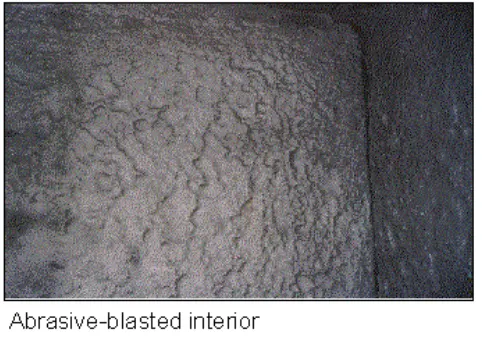
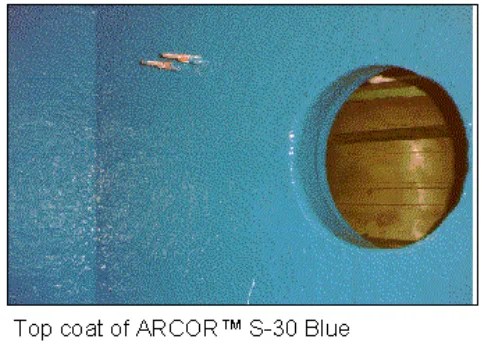
System applied to protect the cast iron substrate from salt water attack and to break electrical continuity between the cast iron waterbox and the Muntz Metal tubesheet, eliminating the galvanic cell at the interface.
The Result
The system was specified to eliminate galvanic corrosion through the dual function of corrosion barrier and electrical insulation at the dissimilar metal interface.

High-performance epoxy systems for industrial repair and protection.